
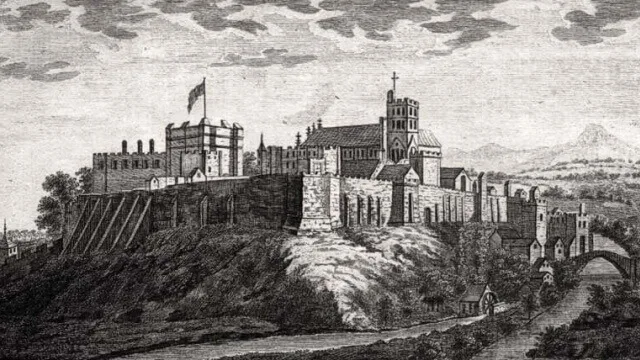
City and castle grew up together in a state of perpetual watchfulness: held to siege ten times in its history, Carlisle Castle is the most besieged place in the British Isles.
Between 1174 and 1461, Carlisle was besieged by the Scots seven times. Notably by Robert the Bruce, fresh from his victory against the English at Bannockburn during the first war of Independence, laid siege to the city from mid July until the start of August before being beaten back by the English forces lead by Sir Andrew Harclay.
In October 1664 during the English Civil War, the city was a Royalist stronghold and besieged by the forces of Oliver Cromwell, lead by Lord Leven, until June 1645 when the Parliamentarians defeated the Royalists at the Battle of Naseby.
The most recent sieges were in November 1745 when ‘Bonny Prince Charlie’ (Charles Edward Stuart) entered the City after a 5 day assault. From there, he lead his army south as far as Derby, before retreating back over the Border leaving a garrison of 400 men in Carlisle to hold back the English pursuit. In a siege that lasted 10 days lead by Prince William Duke of Cumberland, the Jacobites were defeated with 31 executed publicly as warning to the remaining Royalist sympathisers.
Carlisle remained a garrison/military town until 1838, when the post of ‘Governor of Carlisle’ was abolished.
From the 18th century to the 1960s the castle was the headquarters of the Border Regiment, one of the oldest in the army and now houses the Museum of Military Life.
Enjoy the views of this Fortress City from outside it’s ancient walls by Bicycle and visit other locations synonymous with the history of the sieges. Visit the places where Bonnie Prince Charlie stayed in Carlisle and discover the locations of the Jacobite executions, find out who they were and what happened to them?